ICM and SIRIC Montpellier Cancer have reached a milestone with the official launch of Project AMBER, in partnership with TAE Life Sciences. This initiative aims to establish France’s first Boron Neutron Capture Therapy (BNCT) unit in Montpellier, transforming the treatment landscape for poor-prognosis cancers such as certain brain tumors and pancreatic cancer.
A Founding Moment for Project AMBER
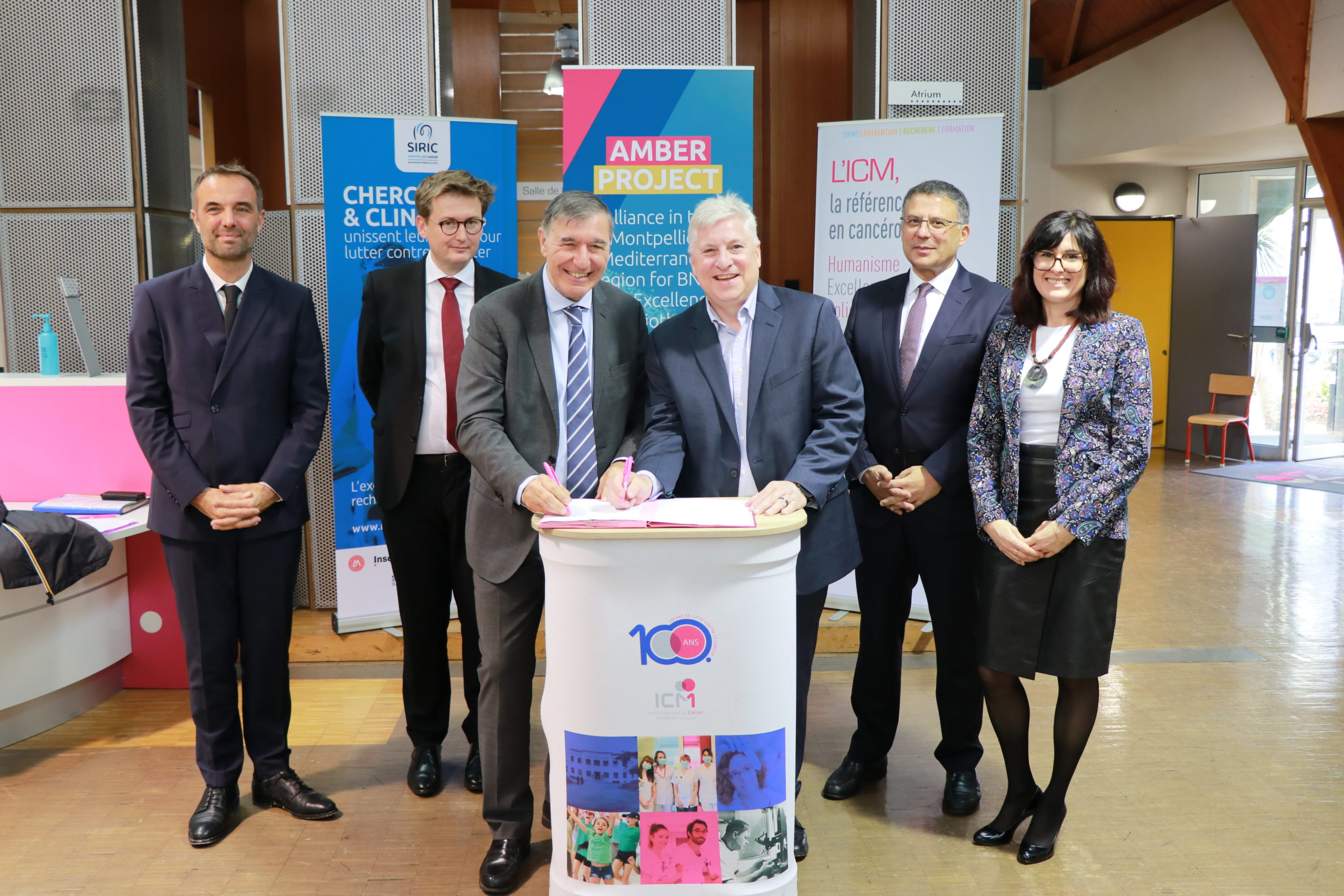
On December 17, 2025, the Montpellier Cancer Institute (ICM) and TAE Life Sciences formalized their collaboration by signing the agreement that officially launches Project AMBER (Alliance Montpellier – Mediterranean for BNCT and Excellence in Radiotherapy). This signature represents the joint commitment of ICM, SIRIC Montpellier Cancer, and their institutional partners to position Montpellier as a pioneering site for this breakthrough radiotherapy technology.
Through AMBER, ICM will become one of the first centers in Europe capable of delivering BNCT within an integrated clinical environment, situated at the heart of a university hospital campus already recognized for its excellence in cancer care.
ICM: Three Decades of Radiotherapy Innovation
For over 30 years, ICM has championed transformative projects in radiotherapy, combining technological innovation, clinical expertise, and high-level research to deliver cutting-edge treatments to patients. The SIRIC Montpellier Cancer designation (Integrated Cancer Research Site) accelerates and strengthens translational research, rapidly converting scientific discoveries into tangible patient benefits. Project AMBER continues this legacy, building upon decades of investment in imaging, radiotherapy, and combined approaches by introducing one of the most promising biologically targeted radiotherapy modalities.
As Professor David Azria, Director of SIRIC Montpellier Cancer, emphasizes, “this project paves the way for an entirely new therapeutic approach to cancer,” with the ambition “to make incurable cancers curable.”
TAE Life Sciences: A Technology Partner at the Forefront
TAE Life Sciences is a leading international player dedicated to developing next-generation BNCT, with a platform combining neutron accelerators and boronated targeting molecules. As part of Project AMBER, the company will deploy its Alphabeam™ BNCT system in Montpellier—a breakthrough radiotherapy technology that positions the region among European leaders in oncology innovation.
“BNCT represents a fundamentally different approach to radiotherapy, combining physics, biology, and precision medicine to selectively target tumor cells while sparing healthy tissue,” explains Rob Hill, Chief Executive Officer of TAE Life Sciences. “We are proud to partner with ICM through Project AMBER and to support France’s leadership in deploying this technology for the benefit of patients with some of the most complex cancers.”
Project AMBER: Advancing Innovation
This system will be integrated with clinical and research teams to develop innovative clinical trials, explore therapeutic combinations, and optimize indications, particularly for high-grade brain tumors and pancreatic cancer.
“With Project AMBER, Montpellier will become France’s pioneering BNCT site, offering new hope to patients with brain tumors and pancreatic cancer,” states Professor Marc Ychou, Director General of ICM.
BNCT: A Disruptive Radiotherapy Technology
Boron Neutron Capture Therapy is an advanced form of biologically targeted radiotherapy based on a two-step principle: first, administration of a boron-containing compound preferentially absorbed by tumor cells, followed by irradiation with a neutron beam that triggers a highly localized nuclear reaction within the cancer cell itself. This reaction releases high-energy particles (alpha and lithium) that destroy the tumor cell from within while minimizing damage to surrounding healthy tissue.
This approach shows particular promise for difficult-to-access or highly infiltrative tumors, where conventional radiotherapy techniques reach their limits.
As Rob Hill summarizes, BNCT “represents a fundamentally different approach” to radiotherapy, at the intersection of particle physics, tumor biology, and precision medicine.
New Hope for Poor-Prognosis Cancers
High-grade brain tumors and pancreatic cancer rank among the poorest-prognosis cancers, despite recent advances in surgery, conventional radiotherapy, and systemic treatments. By selectively targeting tumor cells while better preserving healthy tissue, BNCT opens pathways to potentially more effective and better-tolerated therapeutic strategies.
“With Project AMBER, we affirm our pioneering role in oncology and our ambition to transform the prognosis of cancers currently considered incurable,” emphasizes Professor Marc Ychou. For Professor David Azria, this project “aims to transform ‘care’ into ‘cure’ for cancers with some of the most challenging prognoses” and to accelerate translational research within the MedVallée ecosystem.
A Collective Dynamic and Call to Action
AMBER is fundamentally an alliance—bringing together ICM, SIRIC Montpellier Cancer, TAE Life Sciences, and public and regional stakeholders mobilized around healthcare innovation. Embedded within the MedVallée ecosystem, the project leverages a rich network of expertise in research, industry, healthcare, and education to establish Montpellier as an international reference center for precision radiotherapy.
The project’s success now depends on securing necessary funding and sustained commitment from all partners, both public and private. ICM and SIRIC Montpellier Cancer invite institutional, economic, and philanthropic stakeholders to join this ambitious endeavor, and encourage the public to follow the project’s progress through ICM and SIRIC news updates.